
Choose a Nail Lacquer Top Coat by Compatibility and Finish
Choose a top coat for regular nail lacquer, check gel-like labels, apply it with the right timing, and follow product-specific refresh and removal directions.
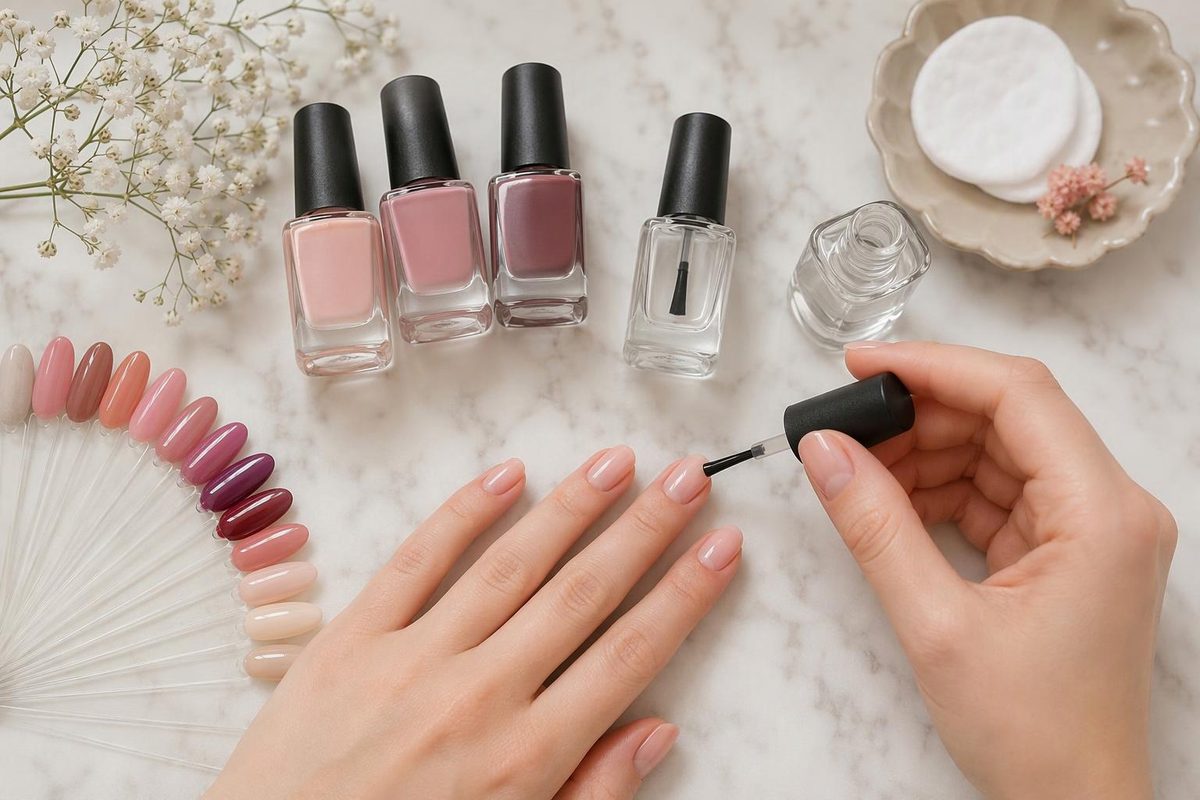
For regular nail lacquer, choose a top coat explicitly intended for air-drying polish, then select the finish you want. A standard glossy lacquer top coat is a practical starting point; a matching long-wear top coat makes sense when your color belongs to a specific system.
Top coat is the finishing layer, not the foundation. OPI describes its regular-lacquer top coat as the final step that seals color and extends wear; base coat goes underneath the color. A clear-looking bottle alone does not tell you which job it does. OPI’s top-coat directions identify both the intended polish type and application sequence.
Choose by the polish underneath
| What you’re using or want | What to look for |
|---|---|
| Ordinary lacquer with a glossy finish | A top coat labeled for regular lacquer, such as OPI Top Coat—not simply a clear color polish. |
| A named, no-lamp long-wear color system | Its recommended finishing coat. For example, Gel by essie specifies two color coats followed by one matching top-coat layer. |
| Faster drying | A lacquer-compatible quick-dry top coat. Compare timing separately from shine and wear. |
| A matte finish | A matte top coat compatible with your lacquer; check whether the color must dry fully first. Essie’s matte about you guidance requires that wait. |
| Glitter lacquer | Follow the glitter polish’s finishing instructions before adding extra layers. OPI’s glitter method calls for completely dry color before one coat of its regular top coat. |
For more specific comparisons, see our guides to quick-drying top coats and satin versus matte finishes.
“Gel-like” does not necessarily mean lamp-cured. Gel by essie’s shiny top coat requires no UV light and removes with ordinary acetone or non-acetone polish remover. Read the directions rather than buying by the word “gel.” A bottle that specifies lamp curing is not the air-dry finishing product described here. Essie documents those no-lamp requirements.
Must the color and top coat be the same brand?
Matching the recommended system is the simplest way to follow the manufacturer’s intended combination. It does not establish that every mixed-brand pairing will fail. Essie says other brands may be compatible with its lacquer, but does not assure the results. Treat a mixed-brand combination as something to evaluate—not a guaranteed wear upgrade. Essie’s compatibility guidance explains that distinction.
Apply it without dragging the color
- Follow your color system’s base-coat instructions. OPI’s regular lacquer sequence starts with base coat on clean, dry nails; Gel by essie specifies no base coat. Do not transfer one system’s shortcut to another.
- Apply the prescribed color layers. OPI’s regular sequence uses two color coats, pulling the second over the nail tips.
- Add the prescribed top-coat layer. OPI calls for one coat, also pulled over the tips—the free edge of the nail. OPI’s complete sequence supports these steps.
There is no single waiting time that fits every top coat. Essie’s general lacquer guidance allows moving to top coat after completing the two color coats across all nails. Holo Taco’s Glossy Taco directions instead say to let the color dry completely. Use your exact product’s instructions, not a universal “apply while wet” rule. Holo Taco also advises a fresh brush dip for each nail, without excessive product, and avoiding repeated strokes over the same area that could drag the color underneath. Essie’s application guidance and Glossy Taco’s directions show why timing and brush handling matter.
Refresh and remove according to the formula
A top coat is intended to help protect the manicure, but a manufacturer’s wear claim is not a head-to-head comparison proving that its bottle lasts longest. Choose first by compatibility and finish rather than an unsupported durability ranking.
Reapplication schedules are product-specific. As of November 2026, Gel by essie instructs users to reapply its top coat on day seven; that is not a universal schedule for lacquer. The same product specifies removal with acetone or non-acetone nail-polish remover. Its current directions cover both maintenance and removal.
If your top coat becomes thick, check its care instructions before altering it. Holo Taco recommends keeping Glossy Taco tightly closed and using a few drops of its nail-polish thinner when needed. That is formula-specific maintenance guidance—not a reason to add remover to every top-coat bottle. Glossy Taco’s storage and thinning instructions explain the method.