
Hard Builder Gel Is the File-Off Option for Structured Nails
Hard builder gel adds structure for overlays and extensions but does not soak off. Compare application, curing, fills and removal before choosing it.
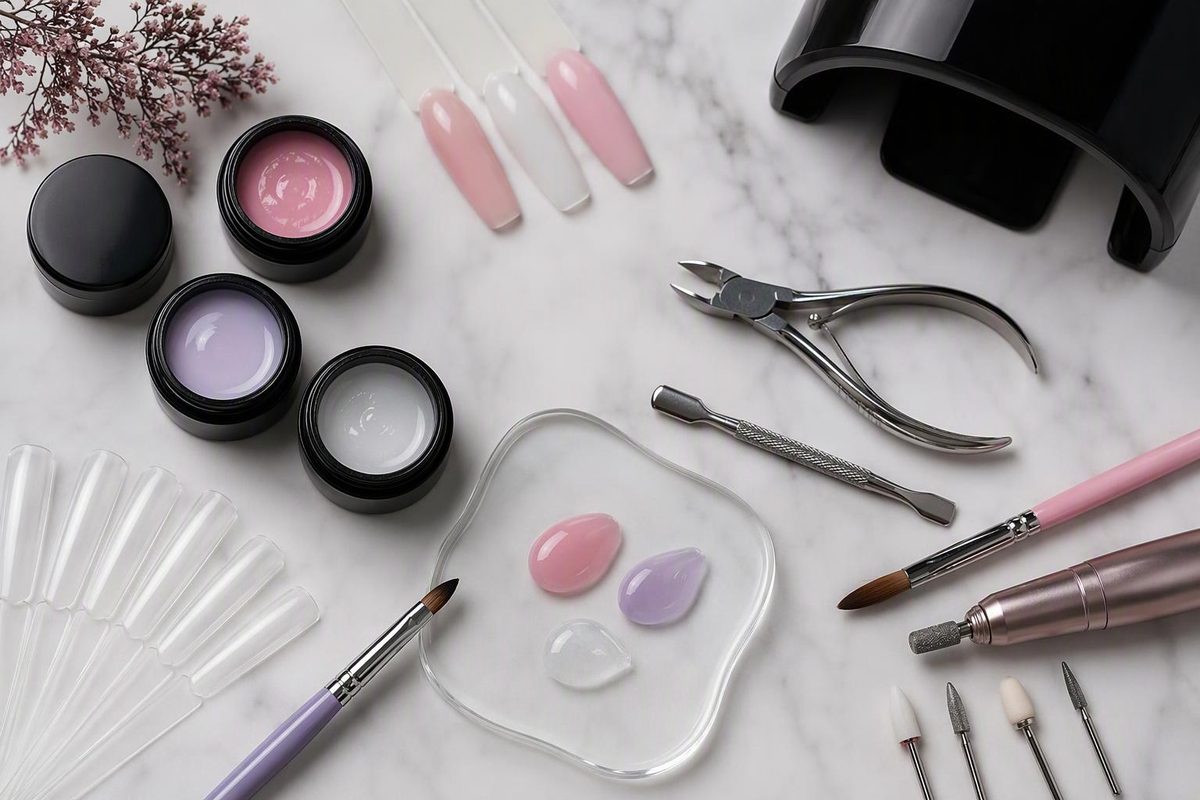
Hard builder gel is a lamp-cured nail enhancement used to create structured overlays, correct shape and sculpt extensions. Builder describes what the product does; hard gel describes the cured system and, most importantly for the wearer, its removal: traditional hard gel is filed rather than dissolved in acetone.
Not every product labeled “builder gel” is hard gel. Some builders are flexible, soak-off products sold in bottles. Packaging alone does not settle the question—read the removal directions for the exact product.
Hard builder gel versus soak-off builder gel
| Feature | Hard builder gel | Soak-off builder gel |
|---|---|---|
| Main use | Structured overlays, reinforcement and sculpted extensions | Structured manicures, overlays and usually shorter extensions |
| Cure | Manufacturer-specified UV/LED lamp | Manufacturer-specified UV/LED lamp |
| Removal | Filed down; not designed to dissolve in acetone | Surface is filed, then product is softened using the specified soak-off process |
| Maintenance | Commonly rebalanced or filled as the nail grows | May be filled or fully soaked off, depending on the system |
| Typical behavior | More rigid, although rigidity varies by formula | Usually more flexible |
| Packaging | Often a pot, but format is not definitive | Often a brush-on bottle, but format is not definitive |
Akzéntz classifies soft gels as porous systems designed for soak-off removal and hard gels as nonporous systems maintained through rebalancing and removed by filing. It also cautions that “hard” and “soft” do not simply mean stronger and weaker; the terms describe different cured behavior and service uses (Akzéntz gel-system guide).
Two Gelish products show why the word builder is not enough. Its Hard Gel Builder is applied from a pot and cured for 30 seconds in the brand’s 18G LED lamp (Gelish Hard Gel Builder instructions). Its Brush-On Builder also creates overlays and extensions, but Gelish explicitly describes that formula as soak-off (Gelish Brush-On Builder instructions).
“BIAB” and “builder in a bottle” therefore should not be treated as universal synonyms for hard gel. Check whether the exact label says hard gel, non-soak-off or file-off. If acetone removal is a priority, look for an explicitly soak-off builder instead. A flexible rubber base gel is another option for short natural nails that need less structure.
What application involves
The product instructions—not a generic cure chart—should control every step. A typical professional service has five stages:
- Assessment and preparation. The existing product and natural nail are assessed, the free edge is shaped, attached cuticle is removed from the nail plate and the nail is prepared as the system directs.
- Base or bonding layer. Some systems require a separate base or bonder; others combine functions. Products are not automatically interchangeable across brands.
- Building the structure. The gel is placed as an overlay on the natural nail or over a form or tip to add length. Product is positioned where support is needed rather than applied as a uniformly thick coat.
- Lamp curing. Each layer is cured in the lamp and for the time specified by its manufacturer. Cure time cannot be inferred safely from lamp wattage alone.
- Finish filing and color. The inhibition layer is handled as directed, and the enhancement is refined with a file. Compatible color and top coat can then be applied according to the system instructions.
Cure requirements differ even between established hard-gel lines. Gelish specifies 30 seconds in its 18G LED lamp for its Hard Gel Builder, while Light Elegance specifies one minute in its LEDdot or MiniDot lamp for 1-Step Lexy Line (Light Elegance 1-Step instructions). One brand’s time should not be copied to another gel or lamp. Conventional gel does not simply dry in air; see why gel-polish curing directions decide.
Fills, rebalancing and removal
As the natural nail grows, the enhancement’s structure moves forward. At a maintenance service, a technician generally removes lifted or excess material, reduces bulk and rebuilds the shape nearer the new-growth area. This is more than hiding the gap with color: the aim is to restore the enhancement’s balance.
There is no guaranteed fill interval. Growth rate, length, nail condition, application and daily use all affect when maintenance is needed. Our builder-gel wear guide explains why common two-to-four-week schedules are planning ranges rather than promises.
For complete removal, do not assume that a long acetone soak will release hard gel. Hard-gel manufacturers describe the system as file-off, and Akzéntz specifies professional filing for removal. The British Association of Dermatologists also notes that buffing and scraping during enhancement removal can physically damage nails (BAD artificial-nail allergy report). Peeling or prying lifted material can remove surface nail layers as well.
If the product identity is unknown, identify the brand and line before removal. Tell the salon that the enhancement may be hard gel, not merely “builder,” because a soak-off builder requires a different process.
When hard builder gel makes sense
Hard builder gel may suit someone who wants:
- a sculpted extension rather than color alone;
- substantial structure or shape correction;
- an overlay intended to be maintained through fills;
- a file-off system rather than repeated full soak-offs.
It may be a poor fit for someone who wants routine at-home acetone removal or does not want ongoing rebalance appointments. Nail flexibility matters too. Light Elegance says its harder 1-Step formula can be too rigid for very bendy nails, while another hard gel in its range is more flexible (Light Elegance 1-Step product guidance). That is product-specific guidance, not a rule that every flexible nail needs the same formula.
Curing and allergy precautions still apply
Hard builder gel contains uncured (meth)acrylate ingredients before adequate lamp curing. The British Association of Dermatologists warns that uncured product touching skin and insufficient curing can increase the risk of sensitization. Its guidance is to avoid direct skin contact, follow the instructions and use the recommended lamp rather than assuming one lamp will cure unrelated products (BAD artificial-nail guidance).
A “HEMA-free” claim means that the stated formula omits HEMA; it does not establish that uncured gel is allergy-safe. Keep gel off the cuticle and sidewalls, remove accidental contact before curing, and do not cure a flooded application. Stop using the product and seek medical assessment for persistent itching, swelling, blistering, nail lifting or a rash around the fingers, face or eyelids.
What to verify before buying or booking
Look for answers to these questions on the exact product’s label or in its manufacturer instructions:
- Is it explicitly hard, non-soak-off or file-off gel?
- Is it intended for overlays, extensions, fills, or all three?
- Which base, bonder and top coat belong to the system?
- Which named lamp and cure time does the manufacturer specify?
- Is the formula suited to the planned length and the flexibility of the natural nail?
- Who will perform fills and controlled file-off removal?
If a listing says only “builder gel” but gives no lamp, cure or removal protocol, it does not provide enough information to treat the product as a complete system.