
Choose Your Nail System by Structure, Curing and Removal
Compare builder gel and dip powder by structure, lamp requirements, wear claims and removal. Learn when soak-off, file-off or infills change the choice.
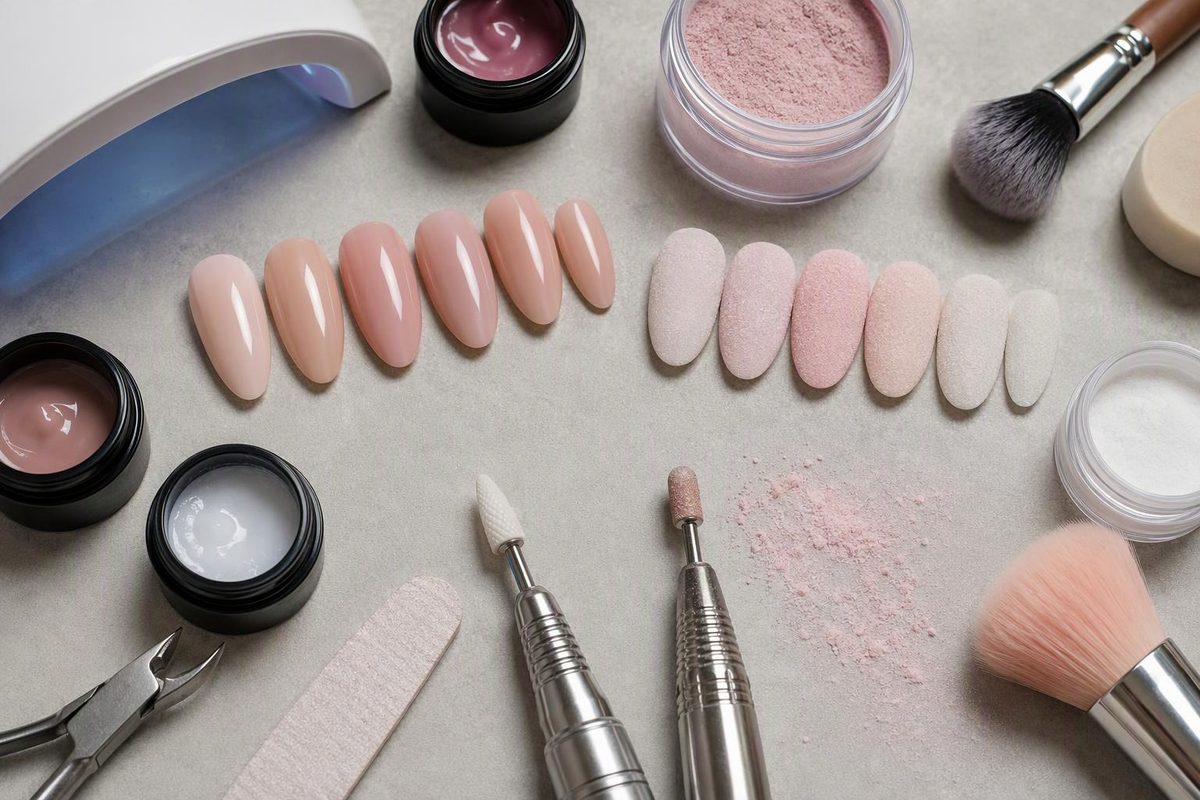
Builder gel is the better fit for a shaped overlay or extensions with an ongoing infill plan. Dip powder is the better fit for a durable color overlay without a curing lamp—provided the entire service uses lamp-free liquids. Neither is automatically healthier or longer-lasting. Before choosing builder gel, confirm whether the exact formula is soak-off or file-off; the name “builder gel,” or its packaging in a bottle, does not establish its removal method.
Choose your priority and acceptable removal method to see which system fits.
Match the System to Your Priorities
Structure With an Acetone Removal Option
Ask for a soak-off builder suited to your proposed nail length. Confirm the exact formula and infill plan; not every builder dissolves in acetone.
Builder still requires its specified curing lamp. Hard BIAB is file-off and does not fit a soak-off-only requirement.
| System | Curing Lamp | Removal |
|---|---|---|
| Soak-off builder | Required | Acetone, per formula |
| Hard BIAB | Required | File-off |
| Conventional dip | Not required | OPI: filing + remover wraps |
Wear Claims and System Caveats
OPI claims 2+ weeks for Powder Perfection; The GelBottle claims 4+ weeks for Hard BIAB. These are manufacturer claims, not a head-to-head test. BIAB guidance recommends infills every 2–3 weeks.
A gel top coat changes a dip service's lamp requirement. Dip removal here describes OPI's protocol, not every brand. Extension suitability depends on the exact builder formula.
Sources: The GelBottle BIAB application, removal and Hard BIAB specification; OPI Powder Perfection overview and hand-removal protocol, linked in the article. No independent comparative wear test.
Builder Gel Adds Structure; Dip Layers Powder and Liquids
| What Matters | Builder Gel | Dip Powder |
|---|---|---|
| Application | Gel is brushed and shaped into an overlay; suitable formulas support extensions. | Powder is layered with liquid base, hardened with activator and finished with top coat. |
| Setting | Requires the specified curing lamp and exposure time. | Conventional liquids and activator can set without a lamp. |
| Shape And Color | Structure can be built separately from color. | Color is commonly incorporated into the powder layers. |
| Upkeep | Some systems allow infills. | Confirm the system and salon’s maintenance plan. |
| Removal | Soak-off or file-off, depending on the formula. | Filing followed by remover wraps is one documented method. |
Builder Gel Creates a Shaped Overlay
Builder application deliberately creates structure rather than simply adding thicker color. The GelBottle’s BIAB application guide instructs users to apply a thin first layer, then build an apex—the raised area that gives the overlay its shape—with a second layer. The guide specifies 99 seconds on low-heat mode in its named lamp for each of those layers. That is a product-specific instruction, not a cure time to copy across brands. The same guide permits gel polish over BIAB.
For longer nails, ask which formula is intended for the proposed length. The GelBottle positions Hard BIAB for long natural nails and sculpted extensions, and explicitly labels it file-off. Our hard builder gel guide explains that removal commitment in more detail.
Dip Powder Is a Complete Liquid-and-Powder System
OPI’s Powder Perfection overview describes repeated powder application followed by activator and top coat; that service requires no LED lamp. Its liquid base-coat ingredient disclosure lists ethyl cyanoacrylate.
If a salon adds a lamp-cured gel top coat, that appointment is no longer entirely lamp-free. Ask which finish is included rather than relying on the word “dip.” For application details, see how to follow your dip kit’s sequence.
Wear Claims Do Not Establish a Category Winner
OPI claims 2+ weeks of wear for Powder Perfection in its overview. The GelBottle claims 4+ weeks for Hard BIAB in its product specification. These are manufacturer claims for named systems, not results from a comparative trial of builder gel against dip powder. We have not independently tested those claims.
The GelBottle’s BIAB removal and maintenance guide recommends infills every 2–3 weeks. An infill fills the growth gap rather than removing the entire overlay. An advertised wear duration is therefore not the same as a maintenance interval.
Choose based on the actual formula, proposed nail length and upkeep plan—not a promise that every dip or builder manicure lasts a month. The available claims do not show which category will last longer on your nails.
Soak-Off Versus File-Off May Decide the Choice
Soak-Off Builder Can Soften in Acetone
The GelBottle’s BIAB removal guide instructs users to break the top-coat seal, wrap with acetone and check after 10–15 minutes. Firm product should be rewrapped, not forced off. That instruction does not apply to every builder formula.
If eventual acetone removal is a requirement, get the exact product name before booking. “Builder gel” alone is not enough information to plan removal.
Hard Builder Requires Controlled Filing
A file-off product needs controlled filing rather than an extended acetone soak. Hard BIAB’s specification explicitly lists file-off removal, despite the product’s BIAB name and bottled format.
If you want to remove the whole set at home, clarify this commitment before application. Arrange professional removal if you are not trained in filing enhancements.
Dip Removal Can Involve Filing and Remover Wraps
OPI’s professional hand-removal instructions call for reducing the product without contacting the natural nail, then wrapping with remover. That protocol also uses salon mitts and a towel.
The first check is after 10–15 minutes with Artificial Nail Remover or 20–25 minutes with Expert Touch Lacquer Remover. If the coating resists, the instructions say to rewrap for another five minutes. These are check points in a specific professional protocol, not guaranteed total removal times for every dip manicure.
Our dip removal guide covers the process separately. OPI documents a soak-off removal service; that does not establish how every dip brand or salon handles maintenance.
Neither System Is Automatically Better for Nail Health
The American Academy of Dermatology’s artificial-nail guidance warns that preparation, removal and frequent touch-ups can leave nails thin, brittle or dry. Covering already damaged nails can worsen existing problems. The choice between builder and dip does not remove those concerns.
Builder Gel Requires Skin-Safe Application and Correct Curing
Uncured product touching skin and insufficient curing can increase allergy risk. Follow the exact system’s lamp instructions and keep gel off skin, as the British Association of Dermatologists advises. A cure time specified for one builder and lamp is not evidence that a different combination will cure correctly.
An LED curing lamp is not necessarily UV-free, as the AAD’s artificial-nail guidance explains. Choosing builder gel therefore does not meet a requirement to avoid curing-lamp exposure.
Lamp-Free Dip Still Has Allergy and Hygiene Concerns
The AAD’s dip-powder guidance identifies dip adhesives as a principal cause of allergic reactions. No lamp does not mean no allergy risk.
The AAD also advises against dipping into a shared container. Use a disposable portion and discard leftovers, or have powder sprinkled onto the nail.
If a manicure causes itching, swelling, blistering or nail separation, stop using the products and seek medical advice rather than immediately switching systems.
Book the Exact Formula and Maintenance Plan
Choose builder gel when shaped structure and an infill service are priorities. Choose conventional dip when avoiding a curing lamp is the priority and you are comfortable with its removal routine. If you want both builder structure and acetone removal, specify a suitable soak-off builder rather than accepting any product sold under that name.
Before paying, confirm the exact product name, whether removal is soak-off or file-off, whether the finish needs a lamp, and the recommended return interval. For cost, compare application plus maintenance plus eventual removal, not just the first appointment price. The sourced material does not provide comparable service prices, so it cannot establish which option is cheaper.