
Two Remover-Free Options for Regular Polish, With Limits
Fresh regular polish or rubbing alcohol may help remove air-dry lacquer. Compare both methods, know when to stop, and avoid using these workarounds on gel.
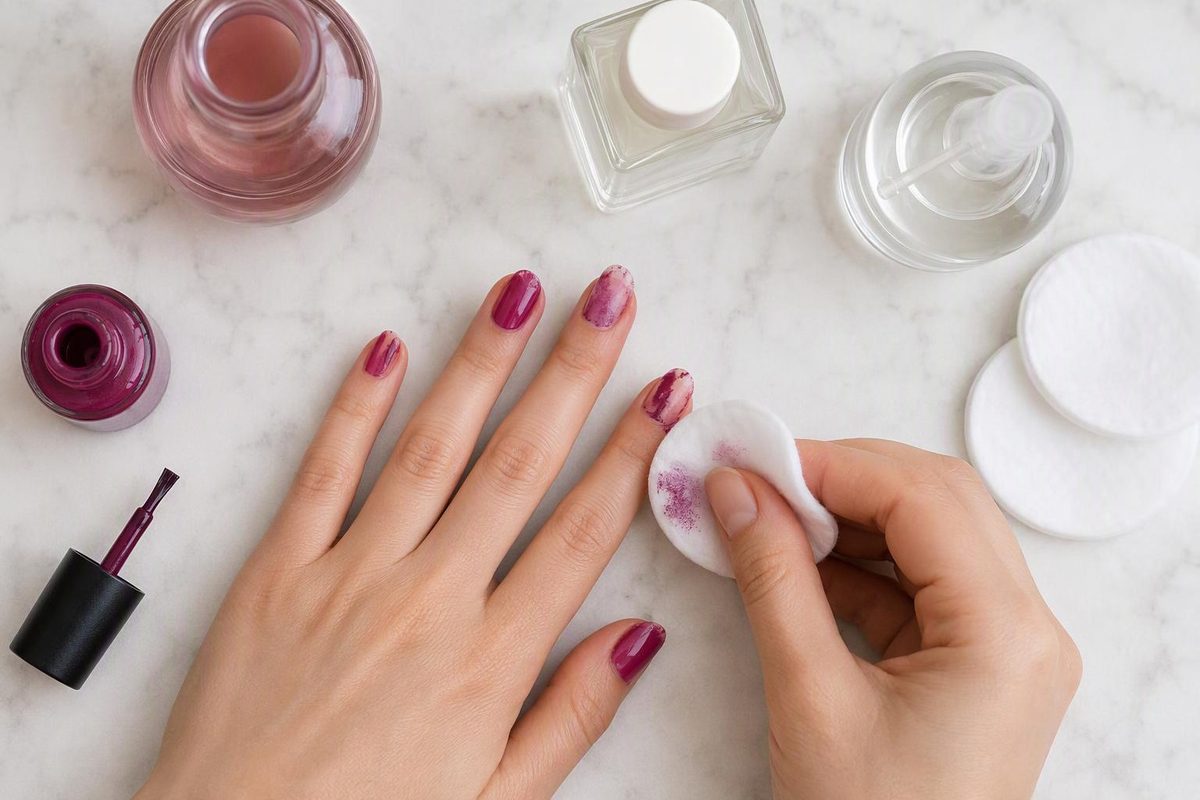
For regular, air-dry nail polish, two ways to remove it without nail polish remover are applying fresh regular polish and wiping it off immediately, or trying rubbing alcohol on cotton. Neither is a guaranteed replacement for remover. Healthline says many household removal methods lack research, and alcohol may work more slowly than conventional remover. These workarounds are not instructions for removing lamp-cured gel, dip powder, acrylic enhancements or builder gel. Healthline’s removal guide
Choose your manicure type and what you have available; the tool gives you the appropriate next step.
Choose A Removal Next Step
Try A Fresh Coat, Then Wipe
Apply fresh regular polish to one nail and wipe it off immediately while wet. Use clean cotton for the next nail.
Complete removal is not established. Stop if the old color will not lift gently. Keep polish away from heat and flames.
Sources: Healthline removal guide; Essie FAQ; AAD gel-removal guidance; Swan topical rubbing-alcohol label via DailyMed. These workarounds were not independently tested.
Confirm That You Have Regular Air-Dry Polish
The distinction that matters is how the product dries, not whether its name contains “gel.” These two workarounds are for ordinary lacquer that dries without a curing lamp. Before trying either, check the exact product’s application and removal directions.
Essie Gel Couture is one example of why the name alone can mislead: Essie says it dries like enamel without a UV or LED lamp. That statement applies to Gel Couture; it does not establish how another brand’s “gel” product dries or comes off. Essie FAQ
If you remember curing your manicure under a lamp, do not treat it as regular polish. If you cannot identify the product, the safer editorial recommendation is to pause rather than use repeated household-solvent attempts to find out what it is.
Also distinguish the color you see from the system underneath it. These instructions address regular polish removal only. They do not provide a way to remove an acrylic enhancement, a dip manicure or a builder-gel structure, even if the surface resembles ordinary polish.
| What You Are Wearing | Remover-Free Next Step |
|---|---|
| Confirmed regular air-dry polish | Try fresh regular polish or topical rubbing alcohol gently |
| Lamp-cured gel polish | Skip these workarounds; see the gel guidance below |
| Dip, acrylic or builder gel | Follow the exact system’s removal directions |
| An unidentified product | Identify it before attempting removal |
Fresh Regular Polish Can Help Lift Old Lacquer
A fresh coat is worth trying if you have ordinary clear polish, regular color polish or an air-dry top coat available. In its glitter-removal advice, Essie says a fresh coat of color or top coat can make the dried polish underneath easier to remove. Healthline describes wiping fresh polish off immediately as an anecdotal workaround, not a proven method of complete removal. Essie FAQ · Healthline
Those are narrower claims than “any top coat removes any manicure.” Essie’s advice concerns making dried polish easier to remove in a glitter-removal context. Healthline supplies the immediate-wipe workaround. Neither source establishes that this will leave every nail completely clean without conventional remover.
Work On One Nail While The New Coat Is Wet
Have your cotton pad ready before you open the bottle. Brush fresh regular polish over one nail, then wipe it off immediately while the new coat is still wet. Use a clean section of the pad for the next nail so you are not spreading removed color back over the surface.
Working one nail at a time keeps the wiping step close to application. Painting all your nails first would give the fresh coat time to dry, which is not the workaround described here. Do not deliberately let the new coat set before attempting to remove it.
Clear polish is an option, not a requirement: the cited advice also mentions fresh color. Use a product you can confirm is regular, air-dry polish. A lamp-cured gel top coat is not a substitute for the fresh regular polish in these instructions.
The useful test is whether the old color comes away with gentle wiping. If it remains firmly attached, stop rather than scraping the nail or pressing harder. A partial improvement does not mean that more force will produce a clean result.
Treat A Partial Result As Partial
You may still have patches of old color after wiping. The available sources do not establish a success rate, a reliable number of applications or which formulas will respond best. We have not independently tested this workaround across polish formulas or finishes.
If you need completely bare nails for your next manicure, this method cannot promise that outcome. Waiting for an appropriate remover is preferable to turning a small remaining patch into a scraping exercise. The purpose of trying fresh polish is to see whether gentle removal is possible, not to commit to removing every trace at any cost.
Rubbing Alcohol Is Another Limited Option
Healthline lists rubbing alcohol applied with a soaked cotton ball as an option for regular polish, while noting that it may take longer than conventional remover. That supports a cautious attempt, not a promise of quick or complete removal. Healthline
Use rubbing alcohol intended for topical use. Dampen a cotton pad or ball, hold it briefly against one polished nail, then wipe gently. Continue only if the polish is coming away without force. If there is no useful progress, wait until you can obtain remover.
There is no evidence-backed contact time or recommended alcohol concentration established in the source material used here. We therefore cannot give you a timed soak, a strength that guarantees removal or a fixed number of attempts. “Briefly” is not an instruction to keep extending contact until something happens.
Keep Alcohol Away From Ignition Sources And Irritated Skin
The Swan rubbing-alcohol label retained by DailyMed directs users to keep the product away from heat, sparks and flames and to use it in a well-ventilated area. It also warns against use on irritated skin and directs users to stop if irritation develops. Follow the label on the actual product you have. Swan rubbing-alcohol label
These precautions are reasons not to treat rubbing alcohol as an unrestricted household substitute. Do not continue rubbing because the color is almost gone if the surrounding skin is becoming irritated. Progress on the polish does not override the product’s skin warnings.
Fresh nail polish also needs to be kept away from heat and flames, as Essie’s FAQ advises. Choosing the fresh-polish method instead of alcohol does not remove that precaution.
Do Not Substitute An Unidentified Alcohol-Containing Product
The recommendation here is specifically for topical rubbing alcohol. It is not an endorsement of every household product whose ingredient list includes alcohol. The cited guidance does not establish that an unrelated spray, fragrance or cleaner is an equivalent nail-polish removal option.
If the only thing you have is a different alcohol-containing product, its alcohol content alone is not enough evidence to recommend putting it on your nails and surrounding skin. Choose the fresh regular-polish method if you have an appropriate product, or wait for remover.
Choose By Availability, Not A Claimed Success Rate
Neither method has a documented success rate in the sources used for this article, and we have not performed a head-to-head removal test. There is no basis here for ranking them as universally faster, gentler or more effective across all regular polishes.
| Available Product | What You Can Try | Main Limit |
|---|---|---|
| Fresh regular polish | Apply and wipe off immediately | Complete removal is not established |
| Topical rubbing alcohol | Apply with cotton and wipe gently | May take longer than remover |
| Both | Choose one cautious attempt | No sourced head-to-head winner |
| Neither | Wait for suitable remover | Other household hacks are not validated here |
Availability makes the practical decision simpler. If you have regular clear polish but no rubbing alcohol, the fresh-coat method is the supported workaround to consider. If you have topical rubbing alcohol but no spare regular polish, alcohol is the other option described by the source.
Having both does not require using both. This article does not establish that alternating them improves removal, nor does it supply a combined procedure. Judge the chosen method by whether color comes away gently and your skin remains comfortable.
Lamp-Cured Gel Needs A Different Removal Plan
For at-home gel-polish removal, the American Academy of Dermatology recommends acetone. It warns that picking or filing off gel polish can significantly damage nails. Its alternative when you do not use remover is to let the gel polish grow out and trim the nails, rather than peel it away. The AAD says fingernails take about six months to grow out completely. AAD gel-removal guidance
That is a slow alternative, not a same-day household removal method. The six-month figure describes complete fingernail growth; it is not a promise that your particular manicure will remain intact or a schedule for removing a specific product.
Do not reinterpret “without remover” as permission to pick, scrape or file gel polish off. The AAD’s warning specifically addresses the damage those approaches can cause. Fresh lacquer and rubbing alcohol are not presented here as substitutes for its gel-removal guidance.
Dip powder, acrylic enhancements and builder gel also fall outside these regular-polish instructions. The AAD gel-polish recommendation should not be treated as a complete removal procedure for those other systems. For dip, use the system-specific steps in our at-home dip-removal guide.
Vinegar, Lemon And Toothpaste Lack A Reliable Procedure Here
We would not build a removal routine around vinegar, lemon juice, toothpaste or peroxide mixtures. Healthline notes that many DIY methods lack research. That leaves little basis for promising that a particular mixture, soak time or amount will remove your polish cleanly. Its guidance also warns that overfiling can remove the nail’s top layer. Healthline’s DIY-method discussion
Lack of research is not proof that every household substance can never affect any polish. It does mean we cannot turn those suggestions into dependable instructions or recommend prolonged experimentation. A recipe with precise quantities would imply evidence this draft does not contain.
Likewise, abrasive scrubbing is not a solution to uncertain solvent performance. If color will not release with gentle wiping, stop. Do not switch from trying to dissolve the polish to wearing away the surface beneath it.
Acetone-Free Remover Is A Separate Choice
Being out of remover and wanting to avoid acetone are different situations. If your goal is specifically to avoid acetone, a formulated non-acetone remover is another category to consider. It still uses solvents, and you need to choose a product intended for your manicure system.
“Non-acetone” does not mean suitable for every type of nail coating, and it is not interchangeable with “non-acetate.” Our remover-label guide explains that distinction. Check the exact remover’s directions rather than transferring a claim from one formula to another.
After removal, wash your hands and moisturize your nails and surrounding skin. If a patch remains while your skin is becoming dry or sore, leave the patch rather than continuing to rub. The stopping point is gentle progress without irritation—not a completely bare nail regardless of what it takes.