
Choose Poly Gel for Structure, Not Easy Soak-Off Removal
Compare poly gel with gel polish and acrylic, check Gelish’s conflicting cure times, and understand filing-based removal, maintenance and allergy risks.
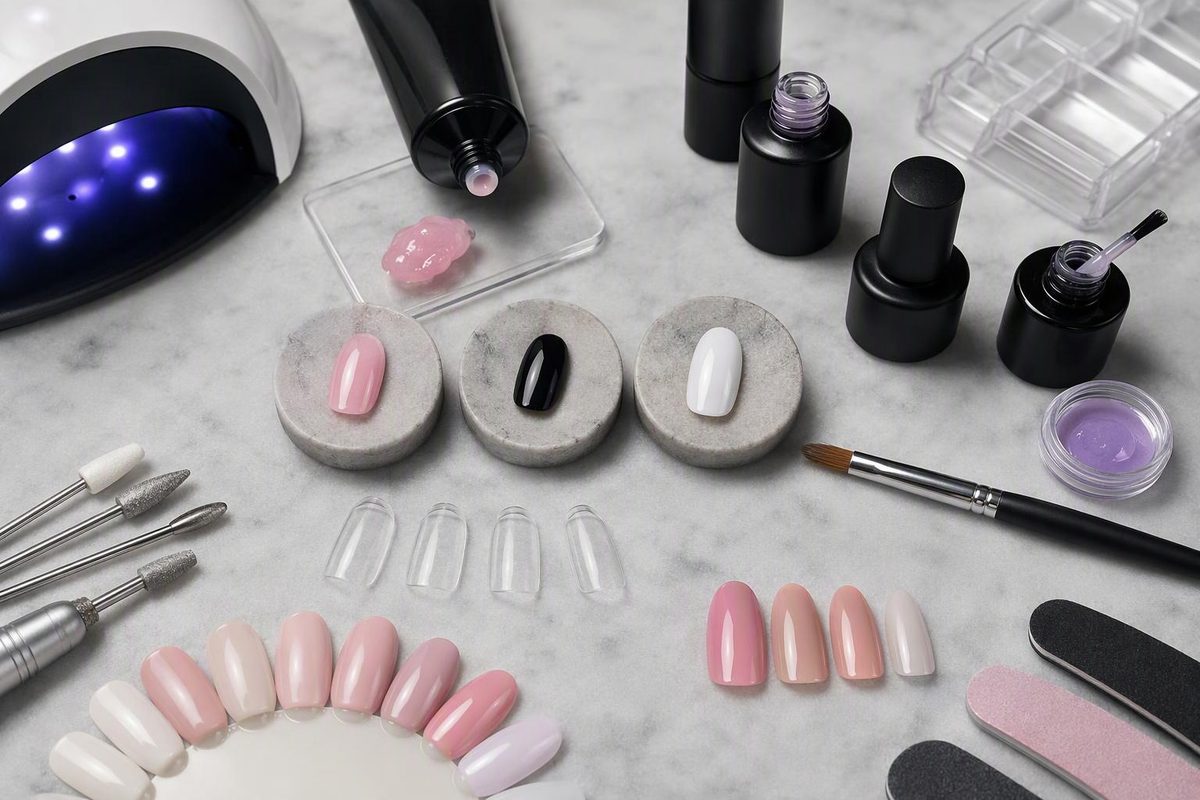
Poly gel for nails is a sculptable enhancement for adding structure over natural nails or creating extensions—not a thin color polish. Gelish’s branded PolyGel system suits that structural goal, but its filing-based removal makes it a poor match if easy soak-off removal is your priority. It comes premixed in a tube, is shaped with a brush and hardens in a curing lamp without mixing acrylic liquid and powder. Gelish’s Master Kit description describes the system, while Nails Magazine’s introduction report documents natural-nail overlays, tip overlays and sculpted extensions. These directions do not establish how every product sold as “poly gel” works.
Choose your nail goal, removal preference and lamp status to check whether the documented Gelish system fits.
Check Your Fit With Gelish PolyGel
Potential Fit for Structural Work
Your preferences align with Gelish PolyGel’s structural role and filing-based removal. Gelish labels its Master Kit for licensed nail technicians only; this result is not clearance for home application or a wear guarantee.
This check covers Gelish’s branded system, not every product called poly gel.
Sources: Gelish PolyGel system directions, Master Kit description and FAQ cited in the article. Published curing instructions conflict; confirm the exact procedure with Gelish when needed.
PolyGel Builds Structure Rather Than Just Adding Color
Using Gelish PolyGel as the documented example, the practical differences are application, curing and removal—not a proven ranking of strength or safety.
| System | Main Role | Hardening | Removal Distinction |
|---|---|---|---|
| Gelish PolyGel | Structural enhancement | Lamp curing | Filing-based |
| Gel polish | Color coating | Lamp curing | Soak-off versions use acetone |
| Traditional acrylic | Structural enhancement | Without a lamp | Not the PolyGel procedure |
| Hard gel | Structural enhancement | Lamp curing | Filing-based |
PolyGel stays workable until lamp curing. Traditional acrylic is mixed from liquid and powder and hardens without a lamp. Gelish positions PolyGel as a separate hybrid system rather than hard gel; that is manufacturer positioning, not evidence of better performance.
These distinctions follow Gelish’s system description and removal procedure and the British Association of Dermatologists’ explanation of acrylic, gel and gel polish. Neither source establishes that one system is universally stronger, safer or longer-lasting. In particular, acetone instructions for soak-off gel polish should not be transferred to Gelish PolyGel.
If color is your main goal, start with what gel nail polish is. For another structural system, compare hard builder gel.
Application Requires a Complete Product System
Gelish labels its PolyGel Master Kit for use by licensed nail technicians only. The service involves preparation, shaping, curing and finishing; the outline below explains what happens rather than replacing training or the manufacturer’s directions.
Preparation Includes a Separately Cured Base
Gelish’s procedure includes shaping the nail, gently removing surface shine, cleansing, applying pH Bond and applying a thin layer of Foundation Base Gel. The base is cured separately before the enhancement is placed.
That sequence matters when comparing a tube of product with a complete service or kit. The tube alone is not the documented application system.
Slip Solution Helps Shape the Product, Not Cure It
The technician squeezes product from the tube, transfers it with the PolyTool and shapes it with the brush and a small amount of Slip Solution.
Gelish describes Slip Solution as a friction-reducing shaping aid, not a curing activator. Its FAQ recommends only its Slip Solution and warns that using too much can cause lifting. Rubbing alcohol or another household liquid should not be assumed to be an approved substitute.
Curing and Finishing Are Separate Steps
After shaping, the enhancement is cured with the specified product-and-lamp combination. The cured material is then filed and smoothed, followed by the specified top coat, which has its own curing and cleansing steps. Gelish’s published application sequence documents these stages.
A generic “poly gel” timer does not account for the exact product, shade or lamp instructions.
Gelish’s Published Cure Times Conflict
Gelish’s cited FAQ specifies 60 seconds for all PolyGel shades in its 18G LED Light, consistent with its detailed application sequence. However, the Master Kit page says 30 seconds in its introductory copy and 60 seconds in its step-by-step section.
That discrepancy is not a reason to choose the shorter timer. If packaging, lamp directions and online instructions conflict, ask the manufacturer to confirm the correct procedure before application. The documented 18G LED Light timing also does not establish a cure time for another lamp.
The British Association of Dermatologists warns that insufficient curing can increase allergy risk and recommends using the lamp specified for the product. Its guidance also identifies contact between uncured product and skin as an allergy risk. A paste that is easy to position still requires careful handling.
Wear Claims Do Not Establish a Guaranteed Lifespan
There is no dependable universal wear time for everything sold as “poly gel.” Gelish promotes adhesion and durability, but those are manufacturer claims—not an independent guarantee of a set number of weeks without lifting or breakage. The cited material does not provide an independent PolyGel wear-test figure.
Wear without failure and the interval between maintenance appointments are different measurements. The American Academy of Dermatology’s artificial-nail guidance says artificial nails generally need touch-ups every two to three weeks as growth creates gaps. That is general maintenance advice, not a PolyGel-specific wear result.
Gelish’s FAQ confirms that PolyGel can be filled or rebalanced. Ask the technician when your chosen length and structure should be reassessed rather than waiting for lifting or breakage to determine the appointment.
Gelish PolyGel Removal Is Filing-Based
Gelish’s removal procedure calls for filing away most of the enhancement without filing the natural nail, then progressively buffing it down, leaving a thin layer and blending the remainder. It does not prescribe an acetone soak as the removal method.
That makes removal skill part of the buying decision. If you cannot confidently distinguish enhancement from natural nail, professional removal is the more practical choice. Trying to achieve a completely bare-looking nail by continuing to file can sacrifice the nail plate.
The AAD guidance cited above notes that filing and repeated artificial-nail maintenance can leave natural nails thin and brittle. It also warns that covering brittle, soft or damaged nails can worsen existing problems. An enhancement should not be used to conceal damage.
For another brand, read that product’s removal directions before choosing it. The category name alone does not tell you whether acetone will work, and Gelish’s filing procedure should not be imposed on a product with different instructions.
Skin Protection and Reaction Symptoms Affect the Choice
Protect Exposed Hands During UV Curing
For gel manicures, the AAD recommends broad-spectrum, water-resistant SPF 30 or higher sunscreen on the hands, or dark opaque gloves with the fingertips exposed. This is general UV-curing advice, not a PolyGel-specific safety test.
Skin protection does not replace keeping uncured product off the skin or confirming the correct lamp and curing instructions.
Stop Use if a Reaction Develops
Itchy redness, swelling or nail separation should not be treated as normal wear. Stop using the product and seek medical advice if a reaction develops. The British Association of Dermatologists’ symptom guidance explains that nail-product allergy can also appear on the eyelids or face.
For someone seeking added structure, Gelish PolyGel offers a premixed, lamp-cured shaping method. The deciding trade-offs remain its technician-only labeling, product-specific curing requirements and filing-based removal—not an independently established advantage in wear or safety.