
Check Your Gel Remover Before Using It Again
Check a gel remover’s label, SDS, and FDA record for methylene chloride aliases, assess instant-removal claims, and choose a safer removal method.
You cannot confirm or rule out methylene chloride with a home test. Check the exact product against FDA records, then inspect its label and matching Safety Data Sheet for methylene chloride, dichloromethane, DCM, methyl bichloride, methylene dichloride, or CAS 75-09-2. If any appears—or the bottle exactly matches an FDA-tested product or recall—stop using it. Because labels may omit the chemical, conventional acetone removal is the safer default when an instant remover cannot be verified.
The concern is substantial: FDA reported 77.1% to 94.4% methylene chloride in ten tested gel-remover samples. Methylene chloride is prohibited in U.S. cosmetics at every concentration; FDA says it has caused cancer in animals and is likely harmful to human health. Appearance, smell, bubbling, and removal speed cannot identify it. Only suitable professional laboratory analysis can confirm what is in a physical sample.
Check the five statements that match your bottle, then compare it with every remover in FDA’s tested-product record.
This editorial score organizes warning signs; it is not a chemical test. An exact FDA match or a listed methylene chloride identifier overrides the score.
Editorial thresholds: 0–1 low, 2–5 medium, and 6 or more high. A disclosed identifier or exact regulatory match means stop using the product regardless of other answers.
Reported range across tested samples: 77.1%–94.4% methylene chloride. The supplied FDA summary does not provide a product-by-product percentage or test year, so those cells are marked — rather than estimated.
| FDA-Listed Product | Test Year | Methylene Chloride | Formal Recall |
|---|---|---|---|
| NIFEISHI Nail Polish GEL REMOVER | — | — | — |
| BORN PRETTY MAGIC GEL REMOVER | — | — | — |
| Candy Lover GEL POLISH REMOVER | — | — | — |
| EELHOE MAGIC REMOVER | — | — | — |
| MOROVAN GEL NAIL POLISH REMOVER | — | — | Yes — about 4,000 units |
| GELLEN TIME TO SHINE Nail Removal Kit | — | — | — |
| AL'IVER Nail Polish Quick Gel Remover | — | — | — |
| AL’IVER Professional MAGIC REMOVER | — | — | — |
| AIBRIT Gel Nail Polish Remover | — | — | — |
| BesTby Gel Nail Polish Remover | — | — | — |
Sources: FDA cosmetic-products testing record and FDA-hosted Morovan company recall announcement. Concentration range reflects tested samples; no product-level percentages are estimated here.
Match the Exact Bottle to FDA Records
Record the complete product name and photograph the front, back, peel-back label, outer packaging, and any printed inserts. Save the bottle size, manufacturer or importer, lot or batch code, production and expiration dates, barcode, seller, order date, and receipt.
Search the complete name rather than the brand alone. Words such as “Magic,” “Quick,” or “Burst” can distinguish products that otherwise look related. A finding for one removal kit does not establish the contents of every remover sold under the same brand.
Compare those identifiers with FDA’s tested-product record and any formal recall notice. The result falls into one of three categories:
- Exact documented match: The name and identifying details align with an FDA finding or recall. Stop using the remover and follow the current notice.
- No match but unresolved documentation: The label is incomplete, the SDS is missing or mismatched, or the packaging resembles a listed product. Keep the bottle closed while checking it.
- Clearly different product: Important identifiers do not match. The cited finding does not establish what is in your bottle, but it does not certify that bottle as safe.
Packaging can match a bottle to a known notice. Bottle color, branding, price, seller location, reviews, and country of origin cannot reveal the composition of an untested product.
FDA analyzed the listed removers using gas chromatography with flame-ionization detection and reported results based on three preparations from the same tested lot. Its findings apply to the samples and lots analyzed, not necessarily every bottle or formulation ever sold under each brand.
Absence from FDA’s table is not a safety certification. The record covers products FDA tested, not every gel remover on the market. Testing and recall status are also different: a recall has its own affected-product description, distribution scope, remedy, and instructions.
Check the Label for Six Identifiers
Inspect the complete ingredient panel, warnings, outer carton, multilayer label, and inserts. Do not rely on a front claim such as “safe,” “natural,” “professional,” or “methylene-chloride-free.”
| Identifier | Meaning |
|---|---|
| Methylene chloride | Common name used by FDA |
| Dichloromethane | Same chemical |
| DCM | Abbreviation for dichloromethane |
| Methyl bichloride | Alternative name |
| Methylene dichloride | Recognized synonym |
| CAS 75-09-2 | Chemical registry number |
If the exact product’s label or credible formulation documentation lists any of these identifiers, do not use it as a cosmetic. CAS 75-09-2 is the most precise cross-reference when a document uses an unfamiliar synonym.
An omission does not prove absence. FDA says cosmetics containing methylene chloride often fail to identify it on the label. A marketplace claim or polished, complete-looking ingredient panel is not an analytical test.
A product-specific statement from the responsible manufacturer can support the documentation trail, but it still does not chemically verify the liquid in your bottle. When the label is missing, implausibly short, or inconsistent with other documents, treat the product as unresolved.
Read the Exact Product’s Safety Data Sheet
Request the current 16-section Safety Data Sheet, or SDS, from the manufacturer, importer, distributor, or responsible supplier. An older document may be called an MSDS. It must correspond to the exact product and formulation you own.
Do not substitute an SDS for pure dichloromethane, generic acetone, another brand, a similarly named remover, or a different formulation.
Read three sections first:
Section 1: Identification. Match the product name, identifier, supplier, intended use, and revision information to the bottle. Resolve a different company or product code before relying on the document.
Section 2: Hazard identification. Review the signal word, pictograms, classifications, and hazard statements. H336, “May cause drowsiness or dizziness,” and H351, “Suspected of causing cancer,” may appear in documentation for dichloromethane. Those codes can support identification when paired with the chemical name or CAS number, but they do not prove that an unknown remover contains it.
Section 3: Composition/information on ingredients. Look for chemical names, CAS numbers, and concentrations or concentration ranges. Search the entire file for all six identifiers in the table above.
Treat the SDS as unresolved if it is generic, incomplete, undated, for another company, inconsistent with the bottle, missing key sections, or supplied as a cropped marketplace image. A missing SDS is a reason to pause, not proof of contamination. A clean-looking SDS is not definitive when it is inaccurate or unrelated to the bottle.
Even a well-matched SDS is supplier documentation. Suitable laboratory analysis is still required to confirm the contents of the physical sample.
Fast “Magic” Removal Is a Warning, Not a Test
“Magic,” “burst,” “instant,” and “quick” claims deserve scrutiny, particularly when the product promises removal in roughly three to five minutes. Other warning signs include bubbling or cracking immediately after application, a missing ingredient list, no traceable responsible company, and no product-specific SDS.
A noticeable sweet or chloroform-like odor has also been associated with methylene chloride, but do not deliberately smell the bottle. Failure to notice an odor does not establish safety. OSHA’s workplace instruments and air-monitoring methods are not household tests for remover liquid. OSHA describes the chemical and its occupational monitoring methods.
Rapid lifting, bubbling, color, texture, and evaporation also cannot confirm composition. Several warning signs together support the conclusion that a product needs verification—not that it definitely contains DCM.
Keep the distinction clear:
- Screening signs justify stopping and checking.
- A matching FDA result, recall, label, or credible exact-product document supplies actionable evidence.
- Professional laboratory analysis can confirm an unresolved sample.
Do not investigate by heating, mixing, decanting, sniffing, or applying the remover to watch its reaction.
The Morovan Recall Has Specific Identifiers
The April 2026 Morovan action is a formal recall, separate from FDA’s broader testing table. The FDA-hosted company announcement says the affected Morovan Gel Nail Polish Remover contained methylene chloride and chloroform. It covered about 4,000 units, with no reported incidents or injuries at the time of publication.
| Detail | Recalled Product |
|---|---|
| Size | 15 mL / 0.5 fl oz |
| Bottle and cap | Square turquoise bottle; white cap |
| Outer packaging | Matching green box |
| Production date | 02-07-2024 |
| Expiration date | 02-07-2027 |
| Seller | Amazon |
| Sales period | August 2025–January 2026 |
If your bottle matches, stop using it and consult the current FDA-hosted recall instructions. The notice directs consumers to mark the bottle and packaging “Recalled,” dispose of the marked product in regular household waste in accordance with local rules, photograph it as directed, and contact customer-service@morovan.com about the announced refund process.
Those directions are product-specific. Do not automatically apply the Morovan disposal instructions to another suspicious remover. If a Morovan bottle differs in size, dates, packaging, or other identifiers, the recall does not establish that it is the same item.
Stop Using a Listed or Unverified Remover
For an exact match to FDA’s tested-product record, stop using the product and keep it closed. For a formal recall match, preserve the bottle, packaging, photographs, dates, and purchase record while following that recall’s refund, return, marking, and disposal directions.
For a suspicious product without a recall match, pause use and request a current product-specific SDS. Check local household hazardous-waste guidance rather than assuming ordinary trash is appropriate. Do not independently mail or transport a suspect chemical unless the responsible authority or recall process gives suitable instructions.
After a spill or noticeable vapor release, leave the immediate vapor area. Ventilate only when that can be done safely without further handling or smell testing, and keep chemical containers closed. California’s cosmetic-safety guidance notes that methylene chloride can be inhaled or absorbed through skin and recommends closed containers and appropriate ventilation.
For questions or possible exposure, contact a healthcare professional or Poison Control at 1-800-222-1222. FDA says the number is available 24 hours a day. Save the product name, label photographs, seller details, purchase date, lot code, and a description of what occurred if reporting a cosmetic-product problem.
Acetone Is the Default for Soak-Off Gel
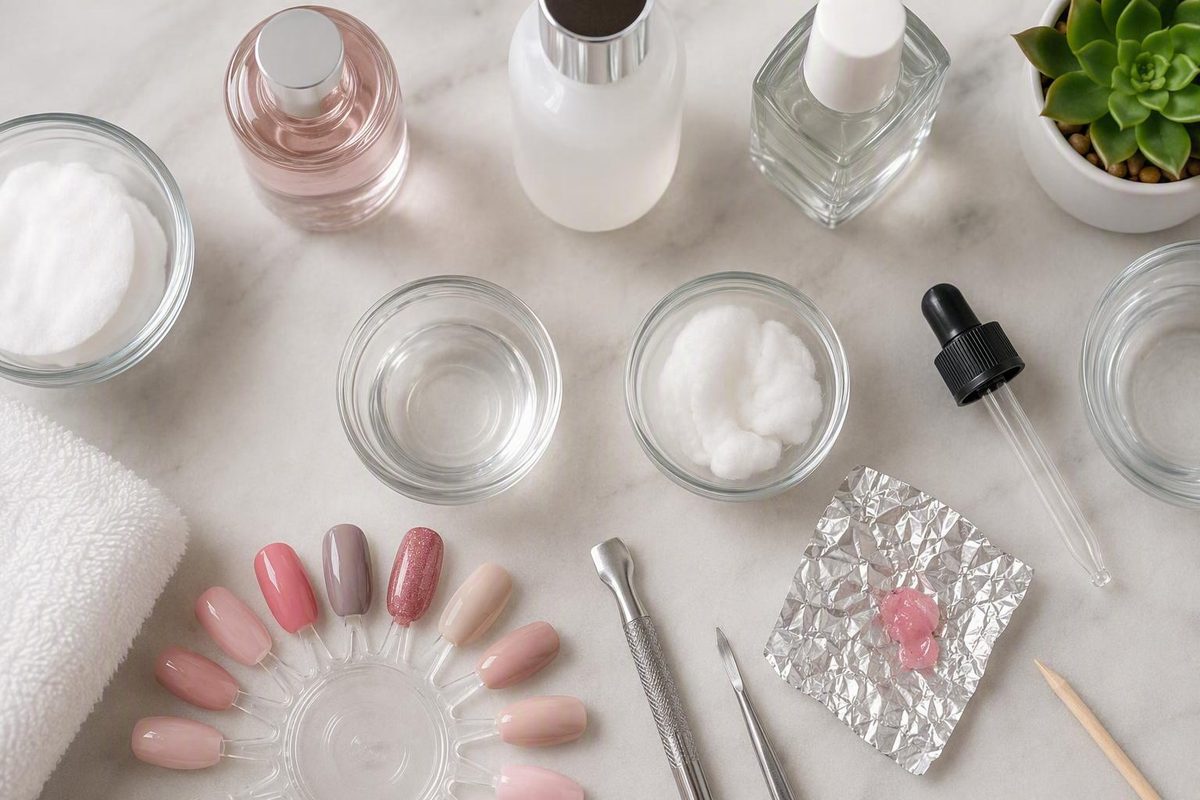
For soak-off gel polish, conventional acetone removal avoids relying on an unverified “magic” remover:
- Gently file through the shiny topcoat without aggressively thinning the natural nail.
- Place acetone-soaked cotton on each nail.
- Wrap each fingertip with foil so the cotton remains against the coating.
- Wait approximately 10 to 15 minutes.
- Unwrap one nail and remove only gel that has softened.
- Rewrap resistant areas rather than scraping forcefully.
The California Safe Cosmetics Program’s guidance recommends filing the topcoat and using acetone-soaked cotton with foil for 10 to 15 minutes as an alternative to suspect instant removers.
Do not peel off the coating or force gel that remains attached. It may need more soak time, or it may not be a soak-off product. Hard gel does not soak off and generally requires filing. Gel Nail Polish Is a Lamp-Cured Liquid Plastic explains the distinction between soak-off and hard-gel systems.
Acetone is not risk-free. Use a properly labelled product, follow its directions, and close the container when it is not in use. When the gel type is uncertain, professional removal avoids excessive soaking, scraping, or filing.
A Missing Ingredient Name Does Not Clear the Product
FDA says cosmetics containing methylene chloride often omit it from the label. Checking all six identifiers and the exact SDS is still worthwhile, but silence on both documents cannot prove the chemical is absent.
There is also no established consumer home test. Smell, appearance, bubbling, and performance cannot confirm or exclude methylene chloride. If the documentary checks remain unresolved, describe the product as unverified and use a conventional removal method instead.