
The UV-Free Claim Is Plausible, but Still Unverified
CND says its new lamp cures above 400 nm. See what the evidence proves, why old formulas may still cure, and which gel systems are validated.
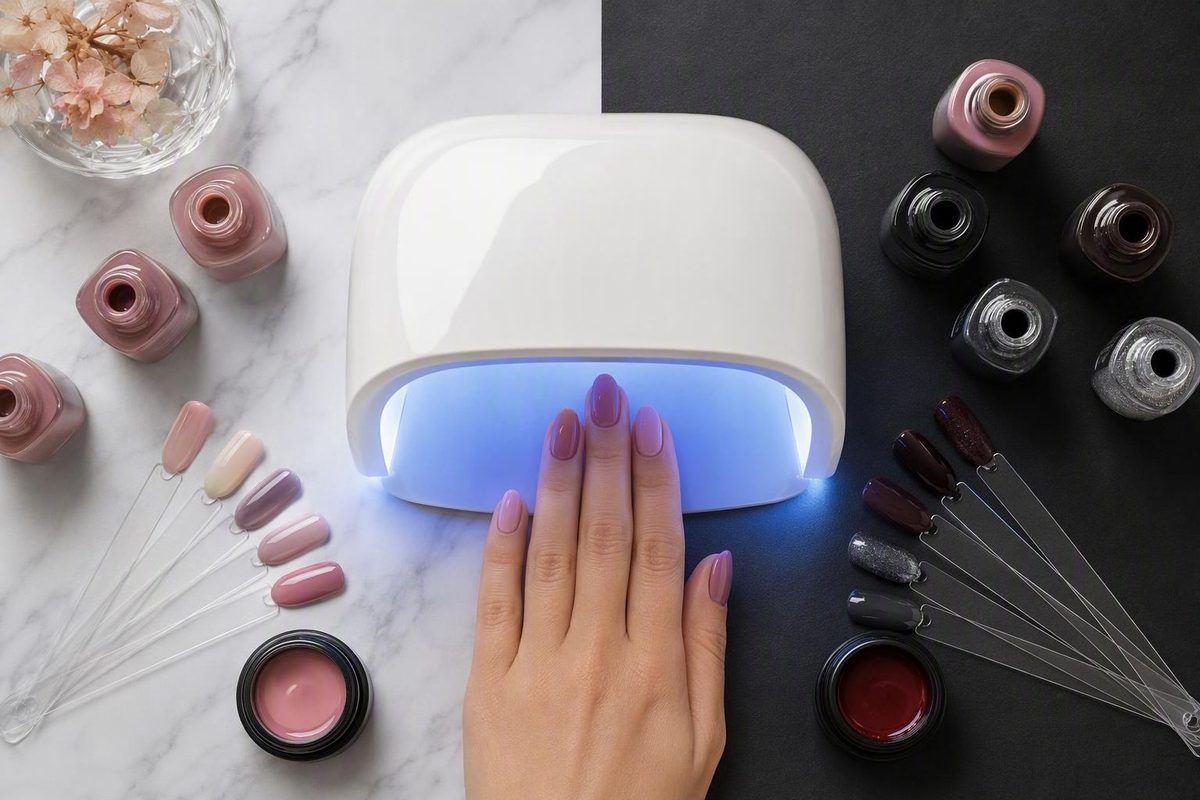
The CND Visible Light Lamp is UV-free according to CND, but not independently verified as UV-free. CND says its curing diodes emit entirely above 400 nanometers, where visible violet begins under the boundary used for this claim. Visible-light curing is technically plausible, but the reviewed evidence contains no complete emission spectrum, measured output below 400 nm, detection threshold, or independent laboratory report for the production lamp.
That distinction matters because “UV-free” can mean either that no UV was detected under a defined test method or that measured UV fell below a stated threshold. CND has made the claim, but it has not published the measurement package needed to tell which standard was met.
Choose a wavelength, lamp, and product to see how the spectral boundary and documented compatibility affect the answer.
Move through the UV–visible boundary, then select the lamp and coating you own. The result separates CND’s claims from independently established facts.
| Wavelength | Classification Here | What The Evidence Says |
|---|---|---|
| 315 nm | UVA lower boundary | Start of the UVA range used in this review |
| 365 nm | UVA | Common curing-diode peak |
| 385 nm | UVA | Common curing-diode peak |
| 400 nm | Practical boundary | UV/visible dividing line used for CND’s claim |
| 405 nm | Visible violet | Common curing-diode peak |
| Above 400 nm | Visible under this definition | CND’s claimed range; exact peak and bandwidth not published |
CND formula photoinitiator identities and numerical absorption ranges: — not disclosed in the reviewed material. A peak above 400 nm does not alone rule out a lower-wavelength emission tail.
| Lamp | Product | Evidence Status |
|---|---|---|
| CND Visible Light | SHELLAC | CND says compatible; no reformulation |
| CND Visible Light | PLEXIGEL | CND says compatible; no reformulation |
| CND Visible Light | BRISA | CND says compatible; no reformulation |
| CND Visible Light | Non-CND gel | Not established; require that brand’s validation |
| CND LED Lamp | SHELLAC | Follow existing product instructions; new FAQ states preset 1 equivalence only |
| CND LED Lamp | PLEXIGEL | Follow existing product instructions; new FAQ does not publish a full comparison |
| CND LED Lamp | BRISA | Follow existing product instructions; new FAQ does not publish a full comparison |
| CND LED Lamp | Non-CND gel | Not established here; require that brand’s instructions |
| Another lamp | Any CND system | Not decided by the new-lamp claim; follow system instructions |
| Another lamp | Non-CND gel | Unknown; use the formula manufacturer’s validated lamp |
| Question | Current Answer | What Would Strengthen It |
|---|---|---|
| Can visible violet cure gel? | Yes, technically plausible; CND reports effective curing | Independent cure-depth and conversion data |
| Is this lamp UV-free? | Claimed by CND; not independently verified here | Full calibrated spectrum and UV detection limit |
| Were CND formulas reformulated? | CND says no | Formula or absorption data; not currently disclosed |
| Is every gel compatible? | No universal compatibility established | Validation from each gel manufacturer |
Why The 400 nm Boundary Controls The Verdict
UV, visible light, and LED are not competing lamp categories. UV and visible light describe wavelength regions. LED describes the technology producing the light; an LED can emit ultraviolet or visible wavelengths.
For this review, UVA extends from approximately 315 to 400 nm, while visible violet occupies approximately 400 to 450 nm. The boundary is not merely semantic. CND’s claim rests on its diodes emitting above 400 nm rather than within UVA.
Industry material identifies 365, 385, and 405 nm as common curing-diode peaks. The first two are in UVA under this boundary, while 405 nm is visible violet (Dymax’s LED curing overview). This is why an “LED lamp” is not automatically UV-free and why a diode-based lamp can genuinely cure using visible light.
CND’s wording that the product works “without UV/LED light technology” is technically imprecise because it combines a wavelength category with a light-source technology. CND-attributed coverage describes the lamp as using visible-light diodes. The sensible interpretation is that its diodes are intended to emit visible curing light instead of ultraviolet light—not that the lamp contains no LEDs.
The exact treatment of 400 nm can also vary by convention. CND’s more specific statement is therefore the useful one: its representative says the output is entirely above 400 nm, rather than merely centered near the boundary (NewBeauty’s report quoting CND).
An Above-400 nm Peak Would Not Prove Zero UV Output
A diode does not necessarily emit at one infinitely narrow wavelength. Its output generally forms a distribution around a peak. A nominal or peak wavelength above 400 nm does not, by itself, establish that every detectable part of that distribution remains above 400 nm.
“Above 400 nm” could describe the selected nominal wavelength, the peak, the center of an emission band, the region containing most output, or a calibrated finding that nothing below 400 nm exceeded a stated detection limit. Those meanings are not interchangeable.
This does not show that the CND lamp has an ultraviolet tail. None of the reviewed sources establishes that it does. It means a full measured spectrum is needed before an outside reviewer can rule out detectable output below the chosen boundary.
A properly documented result would say either that no UV was detected using a specified instrument and geometry or that UV irradiance was below a quantitative threshold. Absolute language is difficult to assess without the test’s detection limit, uncertainty, and operating conditions.
CND’s official Visible Light Lamp product page says visible-light photons cure its light-curable systems without UV wavelengths. That is a specific manufacturer representation, not an independently reproduced result.
Visible-Light Curing Does Not Require An Impossible Chemistry Change
A gel’s photoinitiator must absorb enough of the lamp’s delivered light to start polymerization. Photoinitiators respond across absorption bands rather than according to the marketing category printed on a lamp. A formula that responds sufficiently in visible violet can therefore cure under an above-400 nm source.
That makes CND’s account physically plausible. The company says current CND SHELLAC, PLEXIGEL, and BRISA formulas work in the Visible Light Lamp without reformulation. Existing formulas could continue working if their photoinitiator systems already respond to the lamp’s visible output at the delivered intensity and dose.
The reviewed documents do not identify those photoinitiators, publish their absorption curves, or provide independent depth-of-cure results. It is therefore not possible to compare a disclosed CND absorption range with the lamp’s measured spectrum. Both pieces of product-specific numerical data are absent.
Successful curing would not independently prove that the lamp emits no UV. Cure performance shows that the formula responds to the delivered light and dose; it does not map output across the UV and visible spectrum. The reverse also applies: proving that a lamp emits visible violet does not prove that every gel formula will cure correctly in it.
CND Documents Three Compatible Product Families
CND identifies SHELLAC, PLEXIGEL, and BRISA as compatible with the Visible Light Lamp. These are bounded system claims, not evidence that every gel polish will cure correctly under the new lamp.
The company’s FAQ says the lamp has a 36-watt input, four curing presets, a 60-second preset 1, and an expected visible-light-unit life of 10,000 hours. It also says preset 1 provides a cure equivalent to preset 1 on the CND LED Lamp (CND Visible Light Lamp FAQ).
Those specifications answer workflow questions, not the spectral question. Input wattage describes electrical demand rather than emitted wavelength. Cure duration describes exposure time. Equivalent curing does not establish whether output falls below 400 nm.
| Claim | Evidence Reviewed | Status |
|---|---|---|
| No UV output | CND product materials | Manufacturer-reported |
| Entirely above 400 nm | CND representative | No published spectrum |
| Three CND systems compatible | CND product materials | Manufacturer-reported |
| Preset 1 equivalence | CND FAQ | No independent comparison |
| “Safe and gentle” | CND promotion | Not clinically established here |
CND launched the lamp and relaunched the SHELLAC system on 1 June 2026. Its syndicated announcement says UV is not used in curing and makes broader performance and “safe and gentle” claims. Morningstar notes that the third-party release was not reviewed, verified, or endorsed by it (CND’s launch announcement). Syndication expands a claim’s reach but does not turn it into independent testing.
An Existing CND LED Lamp Does Not Become Obsolete Automatically
The new lamp’s ability to cure unreformulated formulas does not, on its own, show that an existing CND LED Lamp has stopped being suitable. CND’s FAQ specifically compares preset 1 on the two lamps, but the supplied material does not provide a complete old-lamp-versus-new-lamp compatibility study for every product and preset.
Owners should continue using the lamp, preset, application thickness, and exposure procedure specified for their CND system. The new visible-light claim is not a reason to improvise a new setting on an older lamp, but neither is it evidence that a previously validated CND pairing is invalid.
The two lamps should not be assumed to have the same spectrum merely because CND describes a preset as providing an equivalent cure. Different wavelength and irradiance combinations can produce a functional cure when a formula responds to both. Equivalent performance is not equivalent spectral output.
The separate red-light preset on the Visible Light Lamp is not a curing mode. CND says it is an optional spa-like feature and is not intended to cure CND products. It provides no evidence about the output of the actual curing presets.
Non-CND Gel Compatibility Remains Unestablished
The available documentation does not validate non-CND gel polish for the Visible Light Lamp. Compatibility cannot safely be inferred from a hard-feeling surface, a familiar cure time, or the general label “LED gel.”
Correct curing depends on the formula’s photoinitiator response, pigment load, opacity, coating thickness, lamp spectrum and irradiance, hand position, selected preset, and exposure time. A surface can appear hardened without establishing complete cure through the coating.
Use a non-CND formula only if that product’s manufacturer expressly validates it for the CND Visible Light Lamp and supplies the required preset and application instructions. CND’s claims for SHELLAC, PLEXIGEL, and BRISA should not be extended to another brand by assumption.
The same matching principle applies throughout light-curable gel systems. A lamp is part of a curing system rather than a universally interchangeable source. Successful gel curing depends on receiving wavelengths and a dose that match the formula.
Independent Verification Requires A Full Spectral Report
None of the supplied sources includes an independent laboratory report for this model. The reviewed manufacturer material also lacks a complete test report with enough detail for an outside specialist to assess the no-UV finding.
A useful report would identify the exact production model and hardware revision, measured wavelength interval, lamp-to-sensor distance, positions across the hand area, spectroradiometer and optical setup, calibration status, spectral resolution, uncertainty, operating conditions, and the laboratory responsible.
Most importantly, it would publish spectral irradiance as a function of wavelength, the measured results below 400 nm, and the minimum UV output the method could detect. All curing presets should be covered, including any pulsed portions.
Checks during repeated cycles, under battery and mains power, at different charge levels, and after substantial emitter use could show whether the spectrum remains stable under representative conditions. The absence of those checks does not imply that it changes; they would test whether the specification is consistent.
A complete spectrum could confirm CND’s claim, qualify it as below a defined threshold, or identify measurable output below the selected boundary. Until such data are published, the accurate evidence label is manufacturer-claimed UV-free.
UV-Free Is Not A Complete Safety Verdict
Whether a lamp emits UV is narrower than whether the entire service is safe. Spectral verification identifies wavelengths and intensities. A broader photobiological assessment also considers dose, exposure duration, geometry, exposed tissue, and the criteria being applied.
A peer-reviewed scoping review covering 12 studies and five case reports found that output from conventional nail-curing devices varied and was predominantly UVA. In vitro studies identified potential DNA damage, but a direct causal link between nail-lamp exposure and carcinoma had not been conclusively established. The review noted substantial methodological variation and did not evaluate the CND Visible Light Lamp (2025 scoping review).
That evidence shows why “LED” should not be treated as synonymous with “UV-free.” It does not show that this CND model emits UVA, and it cannot establish the model’s health profile.
Even a finding of no detectable UV would leave separate issues such as visible-light intensity and glare, eye exposure, heat, contact with uncured product, ingredient sensitivity, and incomplete curing. The reviewed evidence does not establish that this lamp causes those effects. It shows only that the UV claim cannot resolve every other category.
CND’s “safe and gentle” wording should therefore be treated as promotional positioning unless supported by product-specific comparative exposure, clinical, or photobiological evidence. It is equally unsupported to transfer findings from conventional UVA lamps directly to this model before its output is measured.
The Evidence Supports A Qualified Buying Decision
A buyer comfortable relying on CND’s specification has a coherent basis for treating the lamp as a visible-light curing system. The claim is technically plausible, specific about being above 400 nm, and paired with named compatible CND products.
A buyer requiring independent confirmation does not yet have it in the reviewed record. The missing evidence is not another marketing description but a calibrated spectrum, below-400 nm result, detection threshold, uncertainty statement, and test method for every curing preset.
For practical use, match the lamp to SHELLAC, PLEXIGEL, or BRISA under CND’s prescribed instructions. Continue following the documented system instructions for an existing CND LED Lamp. Treat non-CND gel as unvalidated unless its own manufacturer confirms compatibility.
The resulting verdict is narrow but firm: visible-violet curing is real, and CND may be accurately describing its lamp. The unqualified phrase “100-percent UV-free” remains independently unproven because the supporting spectral measurements have not been published in the materials reviewed.